Mortgage Video Marketing for Loan Officers and Mortgage Brokers Without Filming
Borrowers ask the same things before they ever apply: how much they need down, what a pre-approval checks, how an FHA loan differs from a conventional one. You already answer by phone and email every week. Paste those answers into VidUp and get a narrated, captioned video for your website, your social pages, and the agents who send you buyers, without setting up a camera between closings.
This is your video, rendered from the text above: s, voiced by , music bed. The preview is short and carries the VidUp mark.
Paste your own text and hit Make the video. Create your account for the clean 1080p file, in every size.
In short
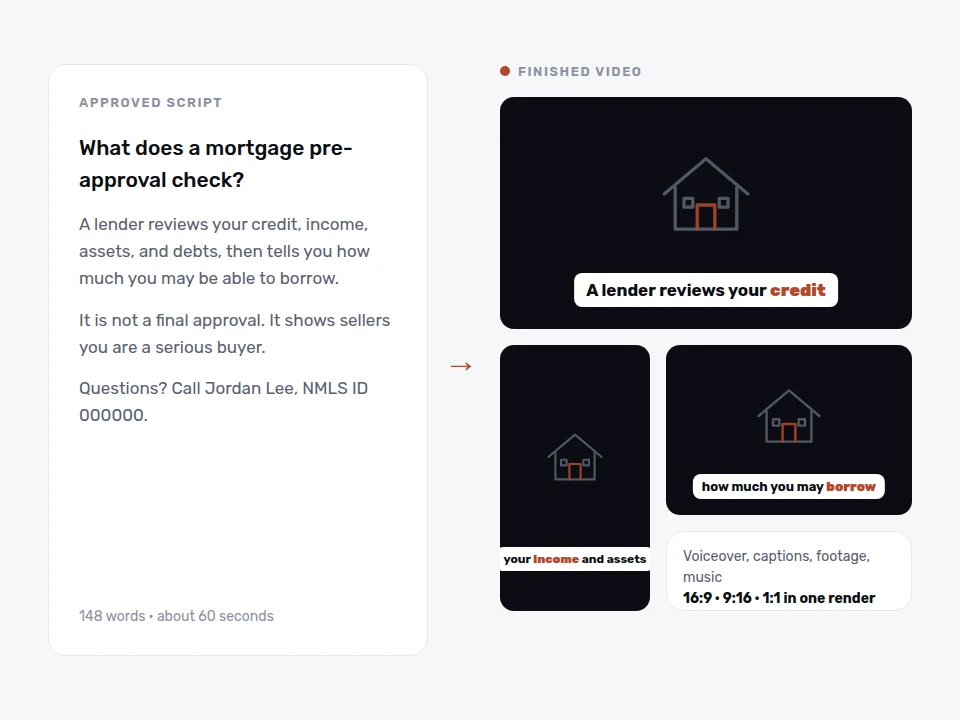
Mortgage video marketing means publishing short videos that answer the questions home buyers and homeowners ask before they pick a lender, then pointing them to your application: loan program explainers, first-time buyer steps, refinance basics, and updates for real estate agent partners. VidUp makes those videos from text. Paste a loan program page, a buyer FAQ, or a blog post and it returns a 1080p MP4 with an AI voiceover, burned-in captions, licensed stock footage, and music, in 9:16 for Instagram and Facebook and 16:9 for your site and YouTube. You approve every word before it renders, which is what your compliance review needs. It costs a flat $49 a month for about 15 to 20 videos, with no credits.
US loan officers, mortgage brokers, and branch teams that want a video for every loan program and borrower question without filming between closings.
A video for every loan program and buyer question
FHA, VA, USDA, conventional, jumbo, down payment assistance, pre-approval, closing costs. Each one is a question a buyer searches before choosing a lender. VidUp turns each answer into a 45 to 90 second video, so your library covers the whole path from first search to closing.
Scripted word for word, so compliance can sign off
An off-the-cuff phone video can slip into a rate or a payment quote that needs disclosures. VidUp reads only the script you paste. Send the same text to compliance, get approval, and the video says exactly that.
One flat monthly cost, no shoot days
A videographer bills per shoot and a mortgage marketing agency bills a retainer. VidUp is a flat plan with no credits, and one funded loan covers years of it.
From a borrower question to a published mortgage video
Pick a question borrowers ask every week
How much down payment a first-time buyer needs, what a pre-approval letter covers, when a refinance makes sense, how a VA loan works. Write the answer in 120 to 250 plain words, the way you would say it on a call.
Keep it general and get it approved
Explain how the program works and who it usually suits. Leave out specific rates, payments, and promises of approval, close with your name, company, and NMLS ID, and send the script through your compliance review.
Paste it into VidUp
VidUp voices the approved script, burns in captions, matches licensed stock footage to each line, adds music, and exports 9:16, 1:1, and 16:9 in one pass. The brand kit adds your logo and colors.
Publish it and hand it to your agents
Post the vertical cut to Instagram, Facebook, and LinkedIn, put the 16:9 file on the matching loan program page and YouTube, and send the link to agent partners to share with their buyers.
Mortgage marketing videos that bring in applications
The mortgage videos that produce applications answer a question someone has right now. A renter working out whether 3 percent down is real. A veteran who has heard about the VA loan and does not know where to start. A homeowner wondering whether to refinance or take a home equity line. A one minute video with a plain answer, your name, and a link to apply reaches that person while they are still choosing who to call, and it stays useful on your site for as long as the program exists.
Start with the programs you close most and the questions you answer most. For most loan officers that is a first-time buyer series (credit, down payment, pre-approval, closing costs), one explainer per program, and a short video for each stage of the process so borrowers know what happens after they apply. The scripts are text you already have: loan program pages, email replies, the checklist you send after a pre-approval, and your newsletter to agents.
Loan program explainers
FHA, VA, USDA, conventional, jumbo, bank statement loans, and down payment assistance. One video per program, general and rate-free, on the matching page.
First-time home buyer series
Credit basics, how much to save, what pre-approval checks, what closing costs include. The questions every new buyer asks, answered once on video.
Process and document walkthroughs
What to upload, what underwriting does, what happens between clear to close and the closing table. Fewer anxious calls mid-file.
Videos for real estate agent partners
A short explainer an agent can text to a buyer, or a program update for the agents who send you business. Useful content is a reason to stay in touch.
Your personal introduction and client testimonials
Not a fit. Borrowers and agents want to see the person they will trust with the loan. Film a short intro on a phone and record happy clients at closing.
Rate quotes and payment examples
Not a fit for an evergreen video. Rates change daily and quoting them brings disclosure rules with it. Keep numbers for the loan estimate.
Where loan officer videos win borrowers and agent referrals
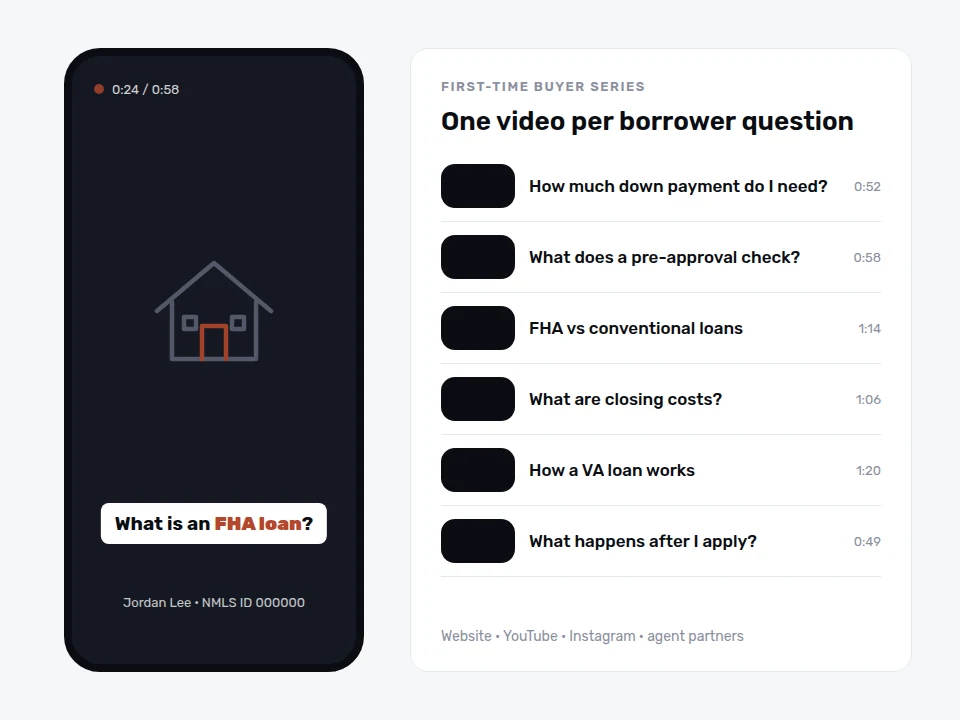
Instagram, Facebook, and LinkedIn are where past clients and local agents see you between transactions. A captioned 45 to 60 second vertical video every week keeps your name in front of the people most likely to refer you. Captions matter here because most people watch with the sound off.
Your website and YouTube are where a buyer who searched a question decides whether to apply with you. Put each program video above the apply button on its own page, and build a YouTube playlist for first-time buyers. One video per question is easier to find and share than a single long overview.
Email, text, and agent partners are the quiet wins. Send the pre-approval video with the pre-approval letter, link the document walkthrough in your welcome email, and give agents a set of videos to share with their buyers. Agents who publish their own listing and market content can do the same with real estate video marketing, and long guides on your site convert to video through the blog to video workflow.
Keeping mortgage videos compliant, and when to film yourself
Mortgage advertising is regulated, and a video counts as an advertisement. Under Regulation Z, stating a trigger term such as a down payment amount, a payment amount, the number of payments, or a finance charge requires additional disclosures, and a stated interest rate must come with the APR. Regulation N prohibits misrepresentations in mortgage advertising and requires keeping copies of ads for 24 months. State rules and lender policies generally require the NMLS ID of the loan officer and the company in advertising, and lenders display the Equal Housing Lender statement or logo. VidUp reads exactly the script you approve and adds no claims of its own, so keep videos general, leave out rates and payments, say your NMLS ID in the closing line so it also appears in the captions, and put the full disclosures in the post text and on the landing page. Your compliance department has the final word, and the script is the document to send them.
Some videos should still show you. A personal introduction, a closing day clip with a happy client, and a joint video with an agent partner build trust because people see who they will work with. VidUp uses licensed stock footage and does not accept uploads, so it will never show your face or your office. A realistic mix is one phone video a week from you plus a steady library of VidUp explainers built from your written answers. Teams that also work with planners and CPAs on referrals can see how those firms handle the same problem on the financial advisor video marketing and video marketing for accountants pages.
Ways loan officers produce marketing videos, compared
Four realistic ways for a loan officer, branch, or mortgage broker to publish video every week. VidUp prices are current list prices. Videographer and agency prices vary by market and are quoted.
| Approach | What it takes | Cost | Best for | Trade-off |
|---|---|---|---|---|
| Film yourself on a phone | A script or talking points, a quiet spot, editing and captions | Your time | Personal intros, market updates, closing day clips | Hard to keep weekly when files pile up, and unscripted takes are harder to clear with compliance |
| Local videographer | Scheduling, a shoot day, edits, review rounds | Quoted per project | A brand film or a batch of on-camera videos once or twice a year | Highest cost per video, and the batch dates quickly when programs change |
| Mortgage marketing platform or agency | A subscription or retainer, often tied to a CRM | Monthly fee, quoted | Branches that want social, email, and video handed off | Template videos shared with many other loan officers |
| VidUp | Paste an approved script, program page, or blog post | $49 a month ($24 yearly) for about 15 to 20 videos; Growth $99 for about 50 with 2 seats | Program explainers, first-time buyer series, process walkthroughs, agent partner videos | Stock footage, not your face or your office |
Keep every video general, leave out rates and payment examples, include your NMLS ID, and route scripts through your compliance review before publishing.
Related pages
More use cases
Related features
The questions buyers ask before they pick a video tool, answered straight.
How do loan officers use video marketing?
Loan officers use video to answer borrower questions before the first call and to stay visible to real estate agents and past clients. Common formats are loan program explainers, first-time buyer tips, process walkthroughs, and short updates for agent partners, posted on social media, the loan officer website, YouTube, and in email.
What videos should a mortgage loan officer make?
Make one video per loan program you close, a first-time buyer series covering credit, down payment, pre-approval, and closing costs, and a walkthrough for each stage of the loan process. Add a personal introduction and client testimonials filmed with real people, since those build trust that stock footage cannot.
Do mortgage marketing videos need an NMLS number?
In practice, yes. State rules and lender advertising policies generally require the NMLS ID of the loan officer and the company on advertisements, and a marketing video is an advertisement. Say it in the closing line, show it in the caption or description, and confirm the exact format with your compliance department.
Can I mention interest rates in a mortgage video?
You can, but it brings Regulation Z disclosure rules with it. A stated rate must be shown with the APR, and trigger terms such as a payment amount or down payment percentage require additional disclosures. Most loan officers keep evergreen videos rate-free and discuss numbers in the loan estimate instead.
How much does mortgage video marketing cost?
It ranges from your own time for phone videos to quoted projects from videographers and monthly fees for mortgage marketing platforms. VidUp is $49 a month, or $24 a month billed yearly, for about 15 to 20 finished videos, and Growth is $99 for about 50 with 2 seats, with no credits and no per-video fees.
How long should a mortgage marketing video be?
Most mortgage videos work best between 45 and 90 seconds. Social posts land around 45 to 60 seconds, and program explainers for a website or YouTube run 90 seconds to 2 minutes. A script of 150 to 250 words makes a video of about one to one and a half minutes.
Make your first video
Paste a script, a blog post, or a product URL and VidUp builds a finished short with voiceover, captions, footage, and music, auto-sized for every platform. Flat plan, no credits.