Roofing Video Marketing and Roofing Marketing Videos Made From Your Service Pages
Homeowners ask your sales reps the same things at every inspection: repair or replace, how long a new roof lasts, what happens on install day, how the insurance claim works, what the warranty covers. Paste those answers into VidUp and get a narrated, captioned video for each service page, your Google Business Profile, Reels and Shorts, and the estimate follow-up text, without sending anyone up a ladder with a camera.
This is your video, rendered from the text above: s, voiced by , music bed. The preview is short and carries the VidUp mark.
Paste your own text and hit Make the video. Create your account for the clean 1080p file, in every size.
In short
Roofing video marketing means publishing short videos that answer what a homeowner asks before booking an inspection or signing a replacement contract, such as whether the roof can be repaired, how long asphalt shingles last, or what the claim process looks like after hail, then sending viewers to your booking page or phone number. The videos that convert best are repair or replace guides, material explainers, install day walkthroughs, storm damage and claim process answers, and warranty and financing videos. VidUp makes those from text. Paste a service page, a sales script, or an estimate note and it returns a 1080p MP4 with an AI voiceover, burned-in captions, licensed stock footage, and music, in 9:16 for Reels and Shorts and 16:9 for your website. It costs a flat $49 a month for 30 videos, with no credits and no film crew.
US residential roofing contractors, storm restoration companies, and exterior remodelers that want a video on every service page and a weekly local video without a shoot day.
A video on every money page
Roof replacement, roof repair, storm damage, metal roofing, gutters, commercial flat roofs, inspections. Each is a page that ranks for a local search and loses visitors who want a quick answer. VidUp turns the copy on that page into a 45 to 90 second video that keeps them there until they book.
Gets the contract signed while the estimate is open
A replacement is one of the biggest checks a homeowner writes for the house, and most want to talk it over first. A one minute video in the follow-up text that explains the two shingle lines you quoted, the warranty on each, and what install day looks like keeps your bid in the conversation at the kitchen table.
Storm response in hours, not weeks
When hail or high wind hits your service area, the companies that post first get the calls. Write a short script on what to check and how the inspection and claim process works, and VidUp returns vertical, square, and wide versions in one render, ready to post the morning after the storm.
From an inspection question to a published roofing video
Pick a question your reps hear at every inspection
Repair or replace, how long architectural shingles last, metal or shingle, what a roof inspection checks, how the insurance claim works, what the workmanship warranty covers. Write the answer in 120 to 250 plain words, the way your best estimator explains it on the driveway.
Keep claims specific and supportable
Say what the service involves, what usually drives the decision, and what the homeowner should expect on the day. Do not promise that insurance will pay or that you will cover a deductible, and close with your company name, service area, license, and how to book.
Paste it into VidUp
VidUp voices the script, burns in captions, matches licensed stock footage of homes, rooftops, and neighborhoods to each line, adds music, and exports 9:16, 1:1, and 16:9 in one pass. Your brand kit adds the logo, colors, and fonts.
Publish it where homeowners decide
Put the 16:9 file on the matching service page, add it to your Google Business Profile, post the vertical cut to Reels, Shorts, and Facebook, run it as a local ad, and send the repair or replace video in every estimate follow-up text.
Roofing marketing videos that turn inspections into signed contracts
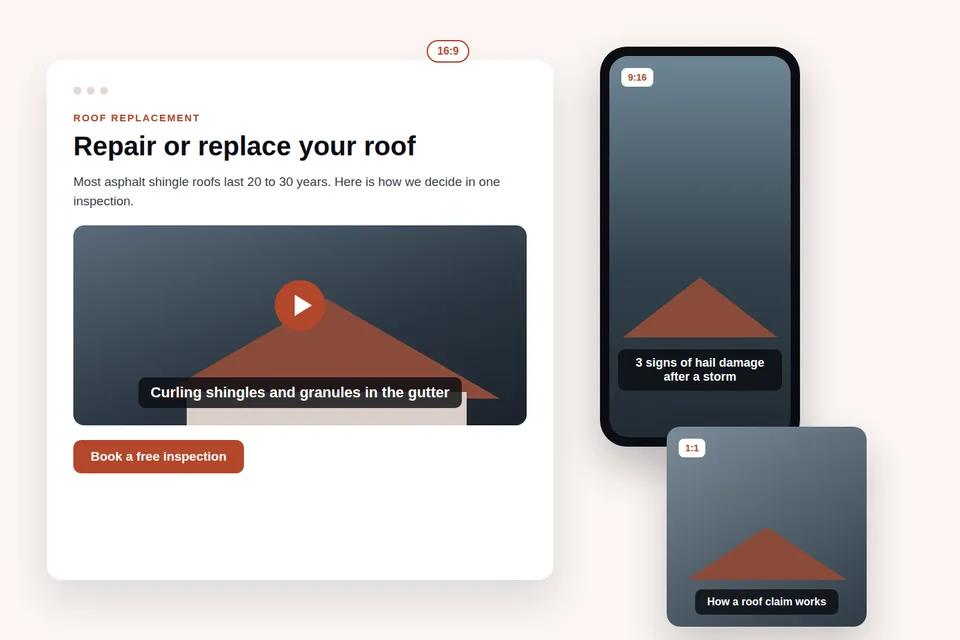
The roofing videos that sell answer a question a homeowner has right now. The couple who found granules in the gutter and a water stain on the bedroom ceiling and want to know if the whole roof has to go. The family in a hail zone who got a knock on the door from a storm chaser and want to know who to trust. The landlord pricing a metal roof for a rental they plan to keep for 20 years. A one minute video with a plain answer, your license number, and a phone number reaches each of them while they are comparing three bids, and it keeps working on your service page for years.
Start with the jobs that carry your margin and the questions that slow down your close rate. For most residential roofers that is a repair or replace video, one explainer per material you install (architectural asphalt shingles, standing seam metal, tile, and TPO or EPDM for low slope), an install day walkthrough, a storm damage and claim process video, a warranty video that separates the manufacturer warranty from your workmanship warranty, and a financing video. The scripts already exist as text in your service pages, sales scripts, proposal templates, and the emails your estimators send every week.
Repair or replace guides
Age of the roof, layers already on it, soft decking, leaks in more than one spot. The video that turns a repair call into a replacement lead.
Material explainers
Architectural shingles, standing seam metal, tile, TPO, and EPDM, with lifespan, look, and cost trade-offs. One video per material, placed on its page.
Storm and claim process answers
What hail and wind damage look like, why a documented inspection matters, and how the adjuster meeting works. Posted the morning after a storm.
Warranty and financing videos
Manufacturer warranty against workmanship warranty, what voids each, and how monthly payment options work. Attached to every proposal.
Drone footage of your jobs
Not a fit. Real before and after shots of a roof you replaced need a drone or a phone on site. VidUp uses stock footage and does not import clips.
Customer testimonials
Not a fit. A review on camera has to be the real homeowner. Record it on a phone after the final walkthrough, with permission.
Where roofing videos win the inspection
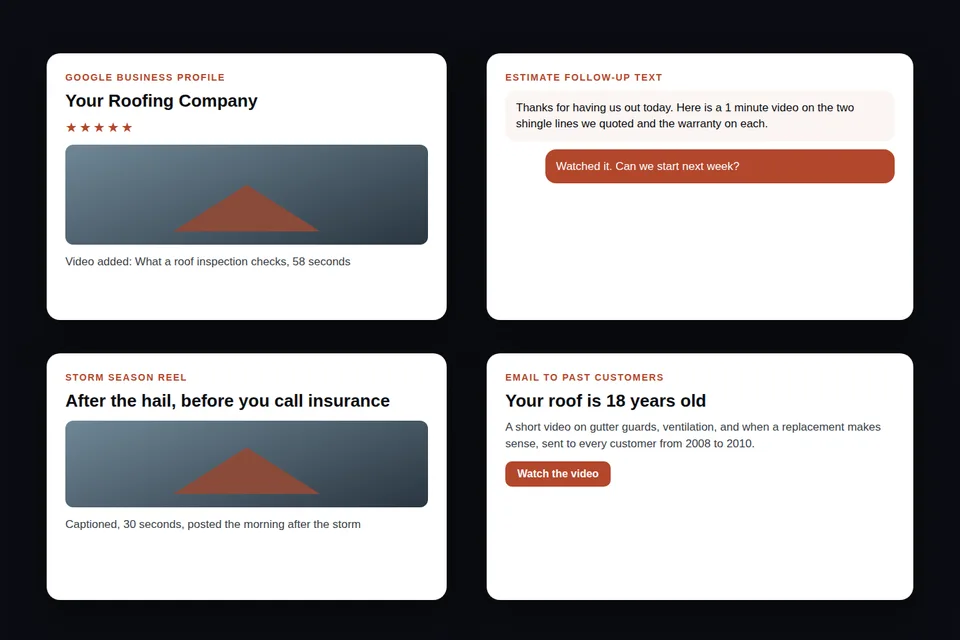
Your website and Google Business Profile are where the inspection gets booked. Put each service video above the call button on its page and add videos to your Google profile, where homeowners compare roofers in the map results after a storm. A visitor who gets a clear answer in a minute has a reason to call you instead of the next listing with the same star rating, and a video that explains your license and warranty separates you from the out-of-state crews that show up after hail.
Facebook, Instagram Reels, and YouTube Shorts keep you in front of homeowners before anything leaks. A captioned 30 to 60 second video every week, signs your roof needs attention, what an inspection checks, why attic ventilation matters, builds a local audience that remembers your name. Most people scroll with the sound off, so the burned-in captions carry the message. Paid local ads use the same files through the AI ad video generator workflow.
Estimate follow-ups, storm alerts, and email are the quiet wins. Text the repair or replace video after every inspection, send the warranty and financing videos with every proposal, and email past customers whose roofs are reaching 15 to 20 years. Companies that also run siding, gutters, or HVAC crews can see the wider approach on video marketing for contractors and HVAC video marketing, and long blog posts on your site convert through the blog to video workflow.
Keeping roofing video claims accurate and when to film your own crew
A roofing video is an advertisement, and the rules that apply to your yard signs and door hangers apply to it. The FTC expects claims to be truthful and backed by evidence, so a line about a roof that lasts 50 years needs the warranty terms behind it. Storm content needs extra care: several states, including Texas and Colorado, make it illegal for a contractor to waive or rebate a homeowner insurance deductible, and only the insurer decides what a policy covers. Explain how the inspection and claim process works, and leave coverage promises out. VidUp reads exactly the script you write and adds no claims of its own, so the script is where accuracy is decided.
Some videos should still show your crew and your work. A meet the team video, drone before and after shots, and homeowner reviews recorded with permission build trust because people are choosing who will be on their roof for two days. VidUp uses licensed stock footage and does not accept uploads, so it never shows your installers, your trucks, or a real job. A realistic mix is one phone or drone clip a week from the field plus a steady library of VidUp explainers built from your service pages and sales scripts. The small business video marketing page covers the same split for owner-operated shops.
Ways roofing companies produce marketing videos compared
Four realistic ways for a residential roofing company to publish video every week. VidUp prices are current list prices. Videographer and agency prices vary by market and are quoted.
| Approach | What it takes | Cost | Best for | Trade-off |
|---|---|---|---|---|
| Film on the roof with a phone or drone | A crew lead or owner, a job site, a drone pilot certificate for commercial drone use, editing and captions | Staff time and equipment | Before and after shots, meet the team, homeowner reviews with permission | Hard to keep weekly in storm season, and editing takes longer than filming |
| Local videographer | A shoot day with a crew, edits, review rounds | Quoted per project | A brand video or a batch of service videos once a year | Highest cost per video, and a crew tied up for the day |
| Roofing marketing agency | A monthly retainer that bundles SEO, ads, and video | Monthly retainer, quoted | Companies that want marketing handed off completely | Content often templated across many roofing clients, plus contract terms |
| VidUp | Paste a service page, sales script, or estimate note | $49 a month ($24 yearly) for 30 videos; Growth $99 for 75 with 2 seats | Repair or replace guides, material explainers, storm and claim answers, warranty and financing videos | Stock footage, not your crew, your trucks, or your jobs |
Keep lifespan and warranty claims tied to the actual terms, never promise insurance outcomes or deductible help, and get permission before showing any customer or home.
Related pages
More use cases
Related features
The questions buyers ask before they pick a video tool, answered straight.
How do roofing companies use video marketing?
Roofing companies use video to answer homeowner questions before the inspection and to stay visible between storms. Common formats are service explainers on each page, repair or replace guides, material comparisons, storm damage and claim process videos, warranty and financing answers, and short weekly tips for Reels and Shorts. The best ones end with a clear way to book.
What kind of videos should a roofing company make?
Make a repair or replace video, one explainer per material you install, an install day walkthrough, a storm damage and claim process video, a warranty video, and a financing video. Add short weekly tips before storm season. Film your own crew and drone footage for before and after content and testimonials, and use a text to video tool for the explainers.
Is video marketing worth it for roofers?
For most roofers, yes, because a single replacement is worth thousands and homeowners pick the contractor they trust, often after comparing three bids. A short video on the service page and in the estimate follow-up text answers questions the homeowner would otherwise take to a competitor. At $49 a month, one signed roof covers years of the plan.
How much does roofing video marketing cost?
It ranges from staff time for phone and drone videos to quoted projects from videographers and monthly retainers from roofing marketing agencies. VidUp is $49 a month, or $24 a month billed yearly, for 30 finished videos with voiceover, captions, footage, and music included. Growth is $99 a month for 75 videos and 2 seats.
How long should a roofing video be?
Reels, Shorts, and local ads work best at 15 to 60 seconds, and service explainers for your website or YouTube at 60 to 120 seconds. A script of 150 to 250 words makes a video of about one to two minutes. Keep each video to one question, such as repair or replace, so the answer and the call to action stay clear.
Can I use these videos in roofing ads on Facebook and YouTube?
Yes. Every VidUp render returns 9:16, 1:1, and 16:9 files, which cover Facebook and Instagram feeds, Reels, YouTube Shorts, and YouTube in-stream ads. You own the exported MP4s and can upload them to any ad account. Keep storm ads factual and avoid promising insurance coverage, which ad reviewers and state laws both watch.
Make your first video
Paste a script, a blog post, or a product URL and VidUp builds a finished short with voiceover, captions, footage, and music, auto-sized for every platform. Flat plan, no credits.